
When you move to France, you may find that your existing advisers and investment platforms can no longer keep you as a client and your existing tax-efficient accounts and trusts may not be recognised by the French tax authorities. Aisa International SAS is a French-regulated investment adviser and insurance broker, specialised in non-French citizens who live in France and French citizens who have worked abroad.
At Aisa International France, we help people make sense of the French system and invest with confidence. This article explains how we work, which French products we can use for you, and how we are remunerated.
Regulated in France by the AMF
Aisa International France is regulated by the Autorité des Marchés Financiers (AMF), the French financial markets regulator. For you, that means:
- French-compliant advice. Our recommendations follow French rules on suitability, so we must understand your situation, objectives and attitude to risk before we recommend anything.
- Transparency on costs. We must disclose our fees and any remuneration we receive, in writing and up front.
- Local accountability. You are dealing with an adviser that answers to the French regulator, not one operating from abroad under rules designed for another market.
Many expatriates are approached by advisers who are not authorised in France, or who sell offshore products that sit awkwardly with French tax rules. Working with an AMF-regulated firm gives you protection and peace of mind.
The full range of French investment solutions
We can use every main type of French investment account. Most other companies specialise in only certain product types. Here is a breakdown of the main accounts available to you:
Compte-titres (general investment and brokerage account)
A compte-titres ordinaire is a flexible, unrestricted brokerage account. You can hold shares, bonds, funds and ETFs from around the world, with no limit on how much you invest and no lock-in. It does not have special tax advantages. From 2026, dividends, interest and gains are generally taxed at the flat rate of 31.4% (12.8% income tax plus 18.6% social charges). It is the type of investment account with the lowest charges and the widest investment choice.
Assurance Vie
Assurance Vie is one of France’s most popylar savings vehicle. Despite its name, it works mainly as a tax-efficient investment wrapper. Inside it you can hold a wide choice of funds, from capital-guaranteed euro funds to equity and bond portfolios.
- Growth is not taxed while it stays inside the contract. Tax is due only on the gains portion of any withdrawal.
- After eight years, withdrawals benefit from an annual allowance on gains of €4,600 for a single person or €9,200 for a couple, with a reduced tax rate above that.
- Assurance Vie was excluded from the 2026 CSG increase, so social charges on its gains stay at 17.2%.
- It is a powerful estate-planning tool: each named beneficiary can generally receive up to €152,500 free of French inheritance tax on premiums paid before age 70, outside the normal French succession rules.
Plan d’Épargne en Actions (PEA)
The PEA is designed to encourage investment in European equities. You can invest up to €150,000 in shares and eligible funds of companies based in the EU or European Economic Area. After five years, gains and dividends are free of income tax, and only social charges are payable. It is open to French tax residents, so it becomes available to you once you have settled here.
Plan d’Épargne Retraite (PER)
The PER is France’s personal pension. Contributions can be deducted from your taxable income, within an annual limit based on your earnings, so it is especially valuable if you pay French income tax at 30% or more. The money is normally held until retirement, with some exceptions such as buying your main home. From 2026, unused deduction allowances can be carried forward for five years instead of three, but contributions made from age 70 are no longer deductible.
Choosing the right funds: the best return after charges for your level of risk
Choosing the right wrapper is only half the job. The funds you hold inside it matter just as much. For whatever level of risk you are comfortable with, our aim is to give you the highest expected return after all charges.
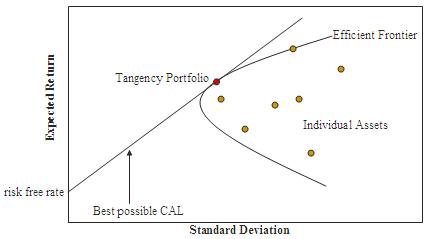
Investment professionals call the set of best possible portfolios the efficient frontier. Each point on it is the portfolio with the highest expected return for a given level of volatility, meaning how much its value is likely to swing up and down. A portfolio below the frontier takes the same risk for less reward.
Charges matter because every euro paid in fund charges, platform fees and adviser commission comes straight out of your return, year after year, while the risk stays the same.
Moving along the curve, from mostly bonds towards a global equity index fund such as one tracking the MSCI World Index, raises the expected return but also the size of the swings you must be prepared to ride out. Our job is to find the point on the curve that matches your goals and comfort with risk, then keep your portfolio on it. High charges push a portfolio below the line, which is why we pay close attention to costs.
Index and passive funds
That is why we consider index and passive funds, such as ETFs and index trackers, alongside actively managed funds. Index funds aim to match a market rather than beat it, and they typically cost a fraction of the charges on many traditional French funds. We recommend an active fund only where we believe it can justify its extra cost.
US citizens: avoiding PFIC funds
US citizens remain subject to US tax wherever they live. Under US rules, most non-US investment funds, including the European funds and ETFs commonly held in French accounts, count as Passive Foreign Investment Companies (PFICs). PFICs are taxed punitively by the US and come with complex annual reporting. For our US citizen clients, we avoid PFIC funds and build portfolios with structures that work for both the French and US tax systems.
Value and dividend portfolios to manage potential AI-bubble risk
Global stock market indices have become heavily concentrated in a small number of very large technology companies, many of them priced on high expectations for artificial intelligence. If those expectations are not met, a portfolio that simply tracks the market could fall sharply.
Where it suits you, we can reduce this exposure and aim to lower the expected volatility of your equity portfolio by focusing on value and dividend strategies. These invest in established companies with lower valuations, steady earnings and regular dividend payments, spread across a wider range of sectors and regions. This approach may lag the market when technology shares are rising strongly. It can, however, offer a smoother ride and more protection if a potential AI bubble deflates.
Ongoing service, not upfront commission
We build long-term relationships, not one-off sales. Our business depends on looking after your money well year after year, not on the commission from a single transaction.
Unfortunately, that is not always the norm in France. Many advisers are paid mainly through large upfront commissions. This can push them towards illiquid investments, such as certain tax-reduction schemes, private equity funds or property-based products. These can tie up your money for eight to ten years or more, with high entry costs and little flexibility if your plans change. For a new resident whose circumstances may still be evolving, being locked in can be expensive.
Our approach is different:
- Liquid, transparent investments. We favour portfolios you can access, adjust or move when you need to.
- Advice that continues. We review your portfolio and your plan regularly, rebalance when markets move, and adapt your strategy as your life, family or tax situation changes.
- Aligned interests. Because we are not relying on upfront commission, our success is tied to yours. If your investments do well and you stay with us, we do well too.
- Clear explanations. We explain the French system in plain English, so you always understand what you own and why.
How we work with new residents
- Initial conversation. We learn about your move, your family, your goals and the assets you are bringing with you.
- Review of your existing investments. We look at what you already hold, in France and abroad, and how it is likely to be treated now that you are French resident. Where specialist tax input is needed, we work alongside your accountant or lawyer.
- A clear recommendation. We set out a written plan showing which French products to use, how to invest within them, and exactly what it will cost.
- Implementation. We open the accounts and set up your investments, handling the paperwork with you.
- Ongoing reviews. We meet regularly to review performance, rebalance and update your plan as your life and French tax rules change.
Whether you have just arrived or have lived in France for a while without reviewing your investments, it is never too early or too late to get organised. Contact Aisa International France to arrange an initial conversation.
This article is for general information only and does not constitute personal financial or tax advice. Tax rules can change and their effect depends on your individual circumstances. The value of investments can go down as well as up, and you may get back less than you invested. Figures reflect French rules as at November 2026.
